

Menstrual Cup Market to reach USD 1.62 Billion by 2035 at 4.91% CAGR
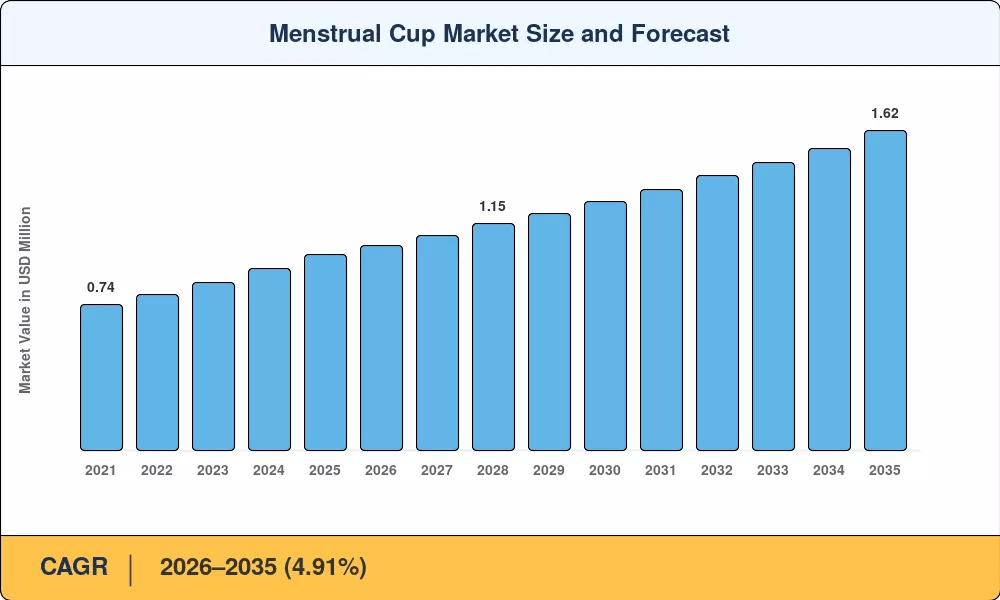
Menstrual Cup Market Size
Menstrual Cup Market to Surge from USD 1.04 Billion in 2026 to USD 1.62 Billion by 2035 — Powered by Sustainability & Plastic Reduction Mandates
NY, CA, UNITED STATES, June 12, 2026 /EINPresswire.com/ -- As per Market Research Future, the global Menstrual Cup Market size to reach USD 1.62 Billion by 2035 from USD 1.04 Billion in 2026, at a CAGR of 4.91% during the forecast period 2026–2035. The market base was estimated at USD 0.99 Billion in 2025.The 4.91% CAGR—anchored in a decisive consumer pivot toward reusable feminine hygiene products rather than discretionary premium spending—is driven by three converging forces: sustainability and plastic-reduction legislation that has repositioned eco-friendly period care as a compliance-driven growth market, government period-poverty programs that transform menstrual flow collection devices from niche goods into public health necessities, and the rise of e-commerce and DTC channels that have lowered the information barrier for first-time adoption through sizing guides, instructional content, and peer reviews.
Environmental analyses consistently show menstrual cups cut lifecycle carbon emissions by roughly 85–90% versus disposable alternatives, a data point that resonates powerfully with Gen Z and millennial consumers willing to pay upfront premiums for sustainability.
National governments and advocacy organizations are amplifying this momentum. Scotland’s Period Products Act—the first national legislation guaranteeing free access to menstrual products—has catalyzed similar policy discussions across the EU and parts of Southeast Asia. France implemented a national reimbursement program for reusable menstrual items for all individuals under 26, significantly accelerating silicone cup trial rates among younger demographics.
India’s Menstrual Hygiene Scheme now reaches millions of teenage girls annually and has begun integrating menstrual cup pilot distributions in five states. Together, these policy and channel innovations are creating the distribution infrastructure and consumer education ecosystem on which the Menstrual Cup Market depends.
Request A Free Sample: https://www.marketresearchfuture.com/sample_request/1407
Key Market Trends & Growth Drivers
Sustainability Mandates and Plastic Reduction Legislation
The EU’s Single-Use Plastics Directive has provided a regulatory tailwind to the Menstrual Cup Market across all 27 member states by limiting certain disposable hygiene goods from 2021. France’s national pharmacy-based reimbursement program for reusable menstrual items targeting individuals under 26 greatly accelerated silicone cup trial rates among younger demographics.
Similar legislative momentum in Australia and Canada positions eco-friendly period care as a compliance-driven growth market rather than a niche lifestyle option. Kenya eliminated the VAT on menstrual goods entirely—a model now referenced in public policy debates from Ghana to Indonesia. These regulations are structurally durable through 2035 and will continue shifting consumer economics in favor of reusable products.
Government Period-Poverty Programs
India’s Menstrual Hygiene Scheme, which reaches millions of teenage girls annually through school-based distribution, is increasingly incorporating menstrual cup awareness modules alongside traditional pad distribution, with active pilot programs now running in five states. Brazil’s 2024 National Menstrual Dignity Program committed BRL 200 million to distribute free menstrual products to low-income women, creating a government-funded entry channel for reusable products. Scotland’s Period Products Act guarantees free menstrual products in all public buildings and has catalyzed similar legislation across the EU and Southeast Asia.
These programs transform menstrual cups from premium consumer goods into essential public health tools, expanding the addressable base in markets that would not otherwise support commercial retail penetration.
E-Commerce and Direct-to-Consumer Channel Expansion
Online platforms are the fastest-growing distribution channel for the Menstrual Cup Market, with Amazon projecting a 40% year-over-year rise in menstrual cup searches between 2022 and 2024. DTC brands such as Saalt and Lunette have reduced adoption barriers through subscription models and personalized size assessments. China’s Tmall and JD.com platforms saw menstrual cup sales double between 2022 and 2024, with live-streamed product demonstrations proving particularly effective at overcoming first-time user hesitation.
DTC brands operating exclusively online achieve 60–70% gross margins versus 35–45% for wholesale-distributed competitors, enabling reinvestment in education content. A seminal Lancet Public Health meta-analysis covering over 3,300 participants across 43 studies confirmed menstrual cups are safe and effective, accelerating OB-GYN referral-driven adoption in North America.
Ask for Customization: https://www.marketresearchfuture.com/ask_for_customize/1407
Market Segment Insights
BY PRODUCT TYPE
Reusable Menstrual Cups: Dominant segment with ~48.7% revenue share in 2025. Favored for their 5–10 year lifespan and per-cycle cost advantage of approximately 90% over disposable products. Consumer surveys consistently rank waste reduction as the primary purchase motivator, ahead of cost savings, confirming eco-friendly values as the segment’s structural foundation.
Disposable Menstrual Cups: Fastest-growing product type at 6.2% CAGR (2026–2035). Serve as a gateway for consumers hesitant about the reusable learning curve. Trial-first purchasing behavior—sampling a disposable cup before committing to a reusable silicone product—sustains growth, particularly in emerging markets where first-time user hesitation is highest.
BY MATERIAL TYPE
Medical-Grade Silicone: Dominant material at 64.8% revenue share (2025). Backed by FDA, CE, and TGA clearance, its ability to withstand repeated boiling sterilization without degradation aligns perfectly with the reusable feminine hygiene value proposition. Brands increasingly offer multiple firmness levels and stem designs to accommodate anatomical variation.
Thermoplastic Elastomer (TPE): Fastest-growing material at 6.6% CAGR (2026–2035). Gaining traction among latex-sensitive consumers as a latex-free, autoclavable alternative offering a softer fold-and-insert experience that reduces first-time user discomfort. Bio-based TPE variants in R&D could achieve compostability certifications by 2028, further enhancing sustainability credentials.
Natural Rubber (Latex): Contributes USD 0.04 Billion (2025). Maintains a presence in cost-sensitive markets due to lower manufacturing cost, though shrinking as consumer awareness of latex allergy risks increases and silicone alternatives become more accessible.
BY DISTRIBUTION CHANNEL
Online Stores: Largest channel at 41.8% share (2025). Platforms deliver the educational content—sizing guides, insertion tutorials, peer reviews, and privacy of purchase—that brick-and-mortar environments cannot replicate at scale. Subscription models and DTC personalization deepen brand loyalty and improve consumer lifetime value by three to four times versus single-purchase transactions.
Pharmacies & Retail Stores: Growing at 4.3% CAGR (2026–2035). Critical for trial-driven purchases in emerging economies where pharmacist consultation builds confidence for first-time users. France’s government subsidy program has made the silicone period cup the fastest-growing product in French pharmacy chains, establishing a replicable model across Europe.
Supermarkets & Hypermarkets: Contribute USD 0.18 Billion (2025). Mass-market shelf visibility and competitive pricing drive impulse trial among consumers who encounter the product alongside conventional feminine hygiene items. Institutional and corporate wellness procurement programs represent an emerging B2B channel bypassing traditional consumer marketing entirely.
Read Detailed Insights: https://www.marketresearchfuture.com/reports/menstrual-cup-market-1407
Regional Outlook
North America — Dominant Market (~35.5% Share, 2025)
The United States generates approximately 78.5% of North American Menstrual Cup Market revenue, driven by a decade-long headstart in consumer education, with brands such as DivaCup and Saalt achieving household-name recognition. Fourteen U.S. states have eliminated sales tax on menstrual products, reducing effective pricing and encouraging trial.
Canada contributes 14.2% of regional share, with British Columbia having become the first province to fund free menstrual products in schools and public buildings in 2023, providing a replicable template for other provinces and normalizing reusable feminine hygiene choices. Mexico is growing at 4.7% CAGR on rising urban middle-class incomes and expanding e-commerce penetration. North America’s leadership rests on mature DTC brand ecosystems, strong retail pharmacy placement, and clinical endorsement depth.
Europe — Second Largest (~28.0% Share, 2025)
Europe’s Menstrual Cup Market benefits from the structural alignment of EU Single-Use Plastics legislation, government subsidy programs, and progressive sexual health education curricula. The UK contributes 22.8% of European revenue, energized by Scotland’s Period Products Act guaranteeing free menstrual products in all public buildings.
France contributes USD 0.06 Billion through its EUR 50 million subsidy program making the silicone period cup the fastest-growing product in French pharmacy chains. Nordic countries—particularly Sweden and Finland—report the world’s highest per-capita menstrual cup usage rates, holding 18.3% of regional share. Germany is growing at 5.4% CAGR on strong green consumer culture and an active pharmacy advisory role. Italy and Spain are growing at 4.2% and 3.8% CAGR respectively as DTC brands and organic retail channels mature.
Asia-Pacific — Fastest-Growing Region (8.1% CAGR, 2026–2035)
Asia-Pacific is the engine of the Menstrual Cup Market, driven by India’s 680-million female population and China’s rapidly evolving e-commerce infrastructure. India is growing at 9.4% CAGR, the fastest country-level growth rate globally, supported by the Menstrual Hygiene Scheme’s expansion into tier-2 and rural districts. China contributes USD 0.05 Billion (2025) with Tmall and JD.com platform menstrual cup sales having doubled between 2022 and 2024. Japan holds 16.2% of regional share on premium consumer positioning and health-conscious culture.
South Korea is growing at 7.8% CAGR driven by K-beauty crossover trends and clean-ingredient purchasing patterns. ASEAN is growing at 8.5% CAGR supported by youth demographics and NGO-led distribution. MRFR projects Asia-Pacific will surpass Europe as the second-largest regional market by 2031 as India and ASEAN markets cross critical awareness thresholds.
Middle East & Africa — Emerging Opportunity (5.8% CAGR, 2026–2035)
The MEA Menstrual Cup Market is characterized by sharp urban-rural divides and represents a high-need, high-potential frontier. The UAE leads with 28.5% of regional share, where expatriate communities and premium health retailers drive silicone period cup adoption. South Africa is growing at 6.1% CAGR supported by NGO-driven school-based programs such as the Caring4Girls initiative.
Egypt is growing at 3.5% CAGR with nascent urban-focused awareness. Organizations such as WaterAid and the Gates Foundation are actively funding menstrual hygiene programs across Sub-Saharan Africa, distributing menstrual cups alongside WASH infrastructure investments. Continent-wide menstrual cup penetration remains below 2% due to cultural barriers and limited sanitation infrastructure, meaning the long-term addressable opportunity is structurally large.
South America — Growing Presence (USD 0.06 Billion, 2025)
Brazil anchors South America’s Menstrual Cup Market at approximately 62.3% of regional revenue, with São Paulo and Rio de Janeiro serving as primary retail hubs. Brazil’s 2024 National Menstrual Dignity Program committed BRL 200 million to free menstrual product distribution for low-income women, creating a government-funded entry point for eco-friendly period care products.
Argentina is growing at 4.6% CAGR, where inflation-driven interest in reusable products is converting cost-conscious consumers to menstrual cups as a long-term savings vehicle. Pan-American Health Organization cooperative programs are gradually improving product access across the rest of the region, though limited distribution infrastructure continues to moderate growth.
Competitive Landscape and Recent Developments
The Menstrual Cup Market exhibits low concentration, with an estimated HHI below 1,000 and the top five companies holding roughly 35–40% of global revenue. The landscape is fragmented across dozens of regional players and DTC startups, with competition centered on material innovation, ergonomic design differentiation, and digital community building rather than price.
A handful of established brands maintain strong recognition in their home markets, while B-Corp certified mission-driven brands and social enterprise models—such as buy-one-give-one programs—are capturing share among values-aligned consumers. Femtech funding reached USD 1.6 billion globally in 2024, with menstrual care capturing approximately 8% of total deals, signaling growing investor interest in brands combining reusable products with digital health data platforms.
KEY COMPANIES AND RECENT MILESTONES
Diva International / DivaCup (2023): Expanded its product innovation suite beyond the foundational DivaCup by launching the Diva Disc and a zinc-infused antimicrobial DIVA Period Underwear line, optimizing leakproof technology and material safety profiles. Maintains ~7–10% global revenue share and the strongest North American pharmacy distribution footprint in the category.
Saalt (February 2022): Launched the Saalt Menstrual Disc, an ergonomic flat-fit reusable disc featuring a custom finger notch for easy mess-free removal, expanding its medical-grade silicone product range. Holds ~4–7% global revenue share as a B-Corp certified, mission-driven brand with high social media engagement and teen-specific product sizing.
Essity / Intimina (September 2021): Expanded global distribution of its compact, collapsible Lily Cup One and Ziggy Disc lines across international retailers, optimizing eco-friendly period care accessibility for first-time users. Benefits from Essity’s global distribution infrastructure and R&D capabilities, holding ~5–8% global revenue share.
Government of India (2022–2023): Under the National Health Mission, updated infrastructure guidelines to actively evaluate sustainable menstrual options and expanded the Menstrual Hygiene Scheme to integrate awareness campaigns around menstrual cups in multiple tier-2 and rural districts, materially expanding the addressable consumer base for the Indian market.
Me Luna GmbH (2024–2025): Continues to lead the TPE segment with the widest size and color range in the category, holding ~3–5% global revenue share. German engineering precision and allergen-free positioning make Me Luna the reference brand for latex-sensitive consumers as the TPE segment grows at 6.6% CAGR.
Ruby Cup (2024–2025): Operates a buy-one-give-one social enterprise model with active NGO distribution partnerships across Sub-Saharan Africa, holding ~2–4% global revenue share. Co-development of culturally adapted smaller-size products with WaterAid and Gates Foundation-funded WASH programs positions Ruby Cup as the leading commercial partner in the emerging-market opportunity.
Future Outlook: 2026–2035
The convergence of menstrual cups with digital health platforms will reshape the market between 2027 and 2032. Sensor-embedded cups capable of monitoring flow volume, pH levels, and cycle irregularities are moving from prototype to clinical trial stages. These devices will position reusable feminine hygiene products as front-line diagnostic tools for conditions such as endometriosis and PCOS, creating data streams valuable to both consumers and healthcare providers. Early femtech pioneers have demonstrated consumer enthusiasm through successful crowdfunded sensor-equipped prototypes, and the Menstrual Cup Market will eventually be redefined as a functional health-data platform.
EU Extended Producer Responsibility regulations, projected to cover all feminine hygiene packaging by 2028, will increase the cost base for disposable product manufacturers and tilt consumer economics further toward menstrual cups. Brands achieving closed-loop silicone recycling—accepting used cups for reprocessing—will capture ESG-driven procurement budgets from institutional buyers. Growing corporate ESG disclosure requirements under the EU’s CSRD and the SEC’s proposed climate rules are simultaneously pushing multinational employers to audit workplace consumable procurement, creating a B2B procurement channel for menstrual cups that bypasses traditional consumer marketing. By 2030, institutional procurement could account for 8–12% of the Menstrual Cup Market in North America and Europe.
MRFR projects that Asia-Pacific will surpass Europe as the second-largest regional Menstrual Cup Market by 2031, driven by India and ASEAN markets crossing critical awareness thresholds. Government health spending across these regions is forecast to grow at 7–9% annually through 2030, with menstrual hygiene an increasingly explicit budget line item. The defining structural shift of this period will be the transition from NGO-funded distribution to commercial retail—a maturation that rewards brands investing now in culturally sensitive education strategies and local material sourcing partnerships.
The alignment of sustainability mandates, period-poverty policy investment, and femtech innovation underscores that public health equity and commercial expansion are now synchronized forces driving the Menstrual Cup Market to its USD 1.62 Billion 2035 destination.
More Related Research Insights:
https://www.marketresearchfuture.com/reports/feminine-hygiene-market-7986
https://www.marketresearchfuture.com/reports/sanitary-pad-market-25183
https://www.marketresearchfuture.com/reports/organic-and-natural-tampons-market-7232
https://www.marketresearchfuture.com/reports/womens-health-devices-market-11263
https://www.marketresearchfuture.com/reports/personal-care-products-market-67529
https://www.marketresearchfuture.com/reports/organic-natural-feminine-care-market-7441
Larry Wilson
WantStats Research And Media Pvt. Ltd.
+1 855-661-4441
email us here
Visit us on social media:
LinkedIn
Facebook
YouTube
X
Legal Disclaimer:
EIN Presswire provides this news content "as is" without warranty of any kind. We do not accept any responsibility or liability for the accuracy, content, images, videos, licenses, completeness, legality, or reliability of the information contained in this article. If you have any complaints or copyright issues related to this article, kindly contact the author above.
